15 September, 2013

Running with the Night

The strangest part of doing a road race at night wasn't the time of the day.  It was figuring out what to do to prepare myself, physiologically, for the timing of the event.  Normally races begin in the morning.  I think about what I should eat the night before, when to wake up, what to eat for breakfast, and the ever-important timing of bathroom/biffy trips.

Night races throw those factors for a bit of a loop. Fortunately, not one that resulted in some unfortunate incident.

The Night Run - Campinas race took place at 8pm on a Saturday, with a course that looped around my preferred running route, the large Parque Portugal, more commonly referred to as Lagoa do Taquaral (Taquaral Lake).  There were 5K and 10K options and I opted for the later.  I honestly cannot remember the last time I raced such a "short" distance, but it was fun to mix it up and nice to do it on such familiar terrain where I knew every incline and curve.

I finished with a time of 43:51 minutes for the 10K and am pretty happy with that!  This put me at 41st overall and 13th in the 30-35 age bracket. 

There was a lot of yellow going on.
The race began, as all road races do, with a significant amount of weaving until people settle in to their appropriate pace-groups.  Since the 5K racers did one lap of the park and the 10Kers did two, the pack was thinning as we got near the end of the first loop, as the runners near me were either 10K racers keeping my pace or 5K champs keeping a decent clip.  I assumed the roads would be as clear and open for the rest of the time, but as I approach the second half of the second lap - kilometer 7ish for me - I encountered an ever-thickening group of 5K...walkers.  Walkers.  This got progressively worse as we neared the finish and the weaving recommenced.

Seriously, who enters a 5K race if you're going to be walking by kilometer 3?  If this were a charity run, I get it.  But you just paid at least $40USD to walk in the dark in an ugly yellow shirt.  Really?!?  And this wasn't just a few people; this is a collective couple kilometers of weaveable people we're talking about. 

With my friend, Claudia, post-race.

Add that to the list of things I don't get about Brazil.  (Along with why the name of the race was in English.  Incidentally, in Portuguese it's pronounced "ny-chee hoon.")

Either way, it was a well-run event and I enjoyed the novelty of night racing.  I would definitely consider doing another!

I should add this to my playlist...

11 August, 2013

Progress Report


As I start my second year in Campinas and Brazil I look back at some of the goals I had when I first touched down in São Paulo 12 months ago.  I did not accomplish all the goals I had set for myself, and as busy as last year was, I am okay with that:
  • Learn Portuguese - Check (?) ...mais o menos. Always in progress!
  • Dance samba - I have gone to samba clubs a couple times, need to make more effort to truly learn and not just slip into salsa.
  • Make a delicious caipirinha myself - As delicious as these are, I try to avoid them for the instant rassaca they give me so this goal is not one I'm motivated to achieve...we'll see.
  • Find a guitar teacher (preferably with limited English) -  Before 2014 it will happen.
  • Get a bike and then bike to work - Not a goal at the moment.
  • Volunteer - Check!  Co-sponsored a school Social Justice Club working with kids in a favela.
  • Find and run a marathon within 12 months of arrival - Check...kind of.  Find?  Yes.  Register?  Yes.  Train for?  Yes.  Marathon postponed until October 2013?  Also, yes.  So...pending.
  • Get back in the pool - Not a goal at the moment.
  • 52 in 52 - Check!
Two original goals are no longer logical or logistical, however, I may decide to refocus on them in the future, so, I will leave them on the master list.  Without Portuguese class twice a week in the evenings anymore, I plan to replace that with guitar classes.

So, what do you do when you've crossed off goals?  You make more!
  • Travel more! 
  • Present at a PD Workshop
  • Finish four Masters classes
  • Get World Cup tickets to see Selección Colombia

24 June, 2013

Well Read


Fifty-two weeks equals one calendar year, any way you slice it.  Last June I set a goal (emulating a good friend who did the same previously) to read a book a week for a year - on average - 52 in 52.

Funny, I expected "52" to look like "more" because it sure felt like it!

I am proud to say that I've not only finished and read some fantastic books, but also learned a lot in the process.

  1. Don't avoid the YA section: I may be way off base, but when I was younger, I feel "young adult" meant Goosebumps and Scholastic Read-a-longs.  Granted, I tore through the Hunger Games series in a little over a week's time, and one of my favorite reads from a couple years ago was Alexie Shermann's phenomenal The Absolutely True Stories of a Part-Time Indian, both of which fall completely into the YA category.  This year two such books landed on my list, both by recommendation: The Scorpio Races and Wonder.  Easily, both contained some of the most memorable literary moments of these past 52 weeks.
  2. I like memoirs: Let's clarify something.  I like memoirs about people who are not "somebodies."  People who have connections to persons of interest or lived through an iconic, world-changing event themselves, but are otherwise unknown.  And they need to be decent writers.  
  3. Toni Morrison is amazing: I have my favorite authors - Dave Eggers, Jonathan Safran Foer, Isabel Allende, Jhumpa Lahiri - but Toni Morrison is a master.  Until further notice, Morrison sits atop my list.  
When I started this experience I set some personal rules.  1) I could quit a book if I wasn't into it.  Just because I started it didn't obligate it being finished, though it in no way negated the week.  2) Speaking of the week, I didn't have to stick to it.  Life happens.  And some books are just really long.  "Average" is the operative word here.  3) Try not to choose books based on length.  Page numbers don't necessarily correlate with length; font size and word spacing can be tricky little bedfellows.  (But, obviously don't pick a 500 page behemoth when you're two weeks behind schedule!)  Basically, be reasonable.

BY THE NUMBERS:

Fiction Books: 36

Short-story Collections (but still Fiction): 5 (maybe 6*)

Non-Fiction (Non-Memoir): 7

Non-Fiction Memoirs/Biographies: 9

Male Authors: 30.5 **

Female Authors: 21.5 **

Oldest Book: The Great Gatsby - 1925 (Second Place: A Tree Grows in Brooklyn - 1943)

Newest Book: The Unchangeable Spots of Leopards - 2013

Books Quit: 3

Books I Wish I Quit But Had Invested Too Much Time to Do So: 2

Books Read on Kindle: 28

Times I Tried Turning a Page of a Real Book By Tapping it: 3 (that I remember)

Longest Title: 12 words (The 100 Year Old Man Who Crawled Out the Window and Disappeared)

Shortest Title: 6 books with single-word titles, though two use only one syllable: Swim and Home 

Repeat Authors: Toni Morrison (with 2 books)

Books recommend by "book friends"***: Jocelyn (4), Annie (3), Sarah Lou (1), Tara (1), Oprah (2) and The Daily Beast (4)

Books That Made Me Cry: Full out - 1, Tear up - 4

Unexpected Repeating Themes: I'm not a "war story" kind of person, however, at least 8 of these books turned out to be undoubtedly about some war.  And 3 books in the list dealt with Nazi Germany in one way or another.


DRUM ROLL...
I had a hard time picking one favorite, so here are my top five BESTS that you must shove to the top of your reading lists (though even this was challenging):
  1. The Unchangeable Spots of Leopards
  2. Birds Without Wings
  3. The Yellow Birds
  4. The House at Sugar Beach
  5. Waiting for Snow in Havana 

* I'm not sure whether to count fantastic The Twelve Tribes of Hattie as a short story collection or not; each chapter easily be isolated from the others, though for full enjoyment it should be read as one masterful work.
**One book, Half the Sky, was co-authored by journalist power-couple Nicholas Kristof and Sheryl WuDunn. I counted it as half so as to end with a total of 52 authors.
***While I got recommendations constantly, I erred on the side of caution and mostly went with those who have yet to steer me in the wrong direction, literarily speaking. 

20 June, 2013

Scream & Shout

This post is a follow-up on a previous post regarding the growing discontent amongst Brazilians with respect to their government and the ensuing public demonstrations.


Front page news shows a woman
getting blasted with pepper spray.
Now that the international media's attention* has been caught and eyes are on Brazilians as they take to the streets ("vem pra rua"), one goal of the people has been met: getting noticed.  If protesters wanted to have their country viewed as more than soccer, beaches, and bikini bottoms, then they have succeeded.

In some ways the demands have even been met.  Or, more accurately, one demand. The original 20 centavo public bus fare price hike from the beginning of the new year has been dropped back to what it was before.  (In Campinas the hike was actually more - 30 centavos.)  But, as many protest signs and online propaganda have alluded to, it is "more than the 20 centavos."  Some have called it the literal tip of the iceberg, while others equate it to only "a drop."

Likely the government is simply attempting to pacify citizens with the removal of the fare increase, though the success of this tactic is yet to be seen.  If it truly is about "more than the 20 centavos," then the protests should continue.  If they stop, the issue - or issues - will likely become more confusing.

The #changebrazil hashtag situation has already won some
celebrity support abroad including Katy Perry, Britney
Spears, and (pictured clockwise from top left) Mark
Zuckerberg, Lady Gaga, Arnold Schwarzenegger, and
Beyoncé.  I've seen others "endorsements" that have been
obviously photoshopped.
In many ways, it already is.  Since the 20 centavos is only the iceberg's tip or one drop of the issue, many citizens have jumped on the bandwagon with their own sets of underlying causes and additional related problems.  Many Brazilians I have spoken to, who support the protests, fear that this lack of laser focus may be the movement's downfall.  What do they want?  Change.  What do they want changed?  Well...everything.

This now becomes another bigger and more complex problem.  This kind of "everything change" only comes with new government officials, which usually only comes from new political parties, and new elections.  And what do these have in common?  They all take time.

Surely more time than lowering bus fares.

Campinas holds its own protest within the hour at the Largo do Rosário in the next neighborhood over from where I live.  So, as I sit typing this now to the symphony of car horns and shouting from car windows 14 floors below me, I wonder what, if any, this continued message will say to the Brazilian powers-that-be and the rest of the world.

"2013: The year Brazil stopped screaming for goals,
and decided to scream for history."
Less Soccer Tournaments (Cups)
More Transportation, Health, and Education.

* Reports from the BBC, The Daily Beast, and The New York Times.

All images were taken off of various Instagram and Facebook postings.

This Much I Know

O Cristo Redentor as seen from the foot of the Corcovado
Mountain in Rio de Janeiro.
Eleven months have both flown by and crawled along.  This seems an appropriate summation of my first year in Brazil as I reflect upon what I have learned about the country and culture after nearly a year: Brazil is a land of extremes.

Having spent five years in Colombia I was used to many differences other North Americans take a while to adjust to - traffic/driving, punctuality issues, lack of personal space, all-night soirées, etc.  However, even things I thought I was used to got ratcheted up a few notches or I was introduced to new cultural quirks.  That being said, these are the Top 5 Thing I Now Know About Brazil, the first edition:

Breakfast on Ilha Grande

  1. What line?  There is no such thing as a line.  Well, there is.  It's the long weaving stretch of people that you just stepped in front of, but whatever. Tudo bom.  It's all good.  You just go ahead and act like you didn't see it.  I've seen this happen to a lesser extent in other parts of Latin America but Brazilians are down-right the grand champions of it.  And it is the one most infuriating cultural thing that I can not seem to let go of.
  2. We want...to pump...you up!  Gym are supposed to have trainers.  Or at the very least workers who maintain the machines and pick up after the lazy gym users who can't seem to put things back even remotely close to where they should be.  Gyms in Brazil often come with enough staff to spot everyone simultaneously.  (Slight exaggeration, but there are an over-abundance of trainers at nearly every gym.)  Having a personal trainer in the US is a luxury you need to pay extra for.  Having one here is expected.  It makes for some awkwardness when you show up at an odd time and there are more trainers than people working out.
  3. Crabby cashiers. Let's just put it this way: I have chosen my preferred grocery stores - there are four within reasonable walking distance from my apartment - by the amount of disdain the cashier's eyes seem to give me.  It sometimes makes me feel as if they have committed a crime and instead of going to prison, have been shackled to the register.  Also, I apparently put them there.  Ouch.  I'm sorry, but I'm excited about my bag of mangos; I'm going home to make juice.  Don't hate.
  4. Spare some change?  No, this isn't the homeless man on the corner.  This every person ever in  Brazil when you pay from something.  Even with small bills.  This has happened to me in Colombia, Peru, Argentina, and Nicaragua.  Where are the smaller denominations being hidden? Quit giving me so many R50 bills at the ATM!  I'm sure there is a logical reason some economist could give me, but honestly I would rather just not have to deal with it.  Again.
  5. So, what do you do?  Brazil takes efficiency and knocks it out with a blunt club, stuffs it in a car trunk, and drives it off a pier.  In the spirit of creating more jobs (?) so many places take one task and divide it into many.  You may go to a club and have one person sell you the ticket as you enter the door and another to take it from you in your next step.  There is a small shopping center in the next neighborhood from mine that has many "stores" but only one central register that handles money.  This means if I want an item at two (or more) different "stores" then each one gets rung up on site, I am given a receipt, and my purchase it whisked away by an eager sales person for me to see again once I finally show up at the central check out and hand over my pile of receipts. Oh, but the cashier I pay doesn't give me my purchase; she just takes my money and gives me another consolidated receipt which I take to another sales person who "finds" my purchases and bags them. This example is extreme, but lesser versions of it exist all over this country.
Samba in Campinas


If this list sounds a bit negative, it is not meant to.  Brazil is a lovely place with many wonderful things to see and a deep, complex history.  I hope the next twelve months bring many more moments of exploration, learning, and understanding.  Mostly, I hope to thicken my skin that much more to ready myself for any lines I may encounter. 

17 June, 2013

Do You Hear The People Sing?

While unrest in Turkey and Syria, among other places, has the US media's current collective attention, expect it's focus to turn south soon.  Brazilians are taking to the street!

It's no secret that Brazil has a love affair with soccer.  It's also no secret that the country has dealt with its fair share of corruption in government.  It's ironic then, that this soccer-obsessed nation is taking such a firm stand against the prestigious hosting of several major world sporting events - currently the Confederation Cup, the FIFA World Cup in a year, and the Olympics in 2016.

Many are upset at the use of government (and tax) money to fund these events when most citizens realistically will not only be unable to enjoy them, but worse, are being caused more financial hardship from increases in cost-of-living and supposed lack of funds going towards education, transportation/infrastructure, and health care.

All one has to do is read the signage as protesters have taken [mostly] peacefully to the streets of São Paulo, Rio de Janeiro, Belo Horizante, Brasília, Salvador, and other cities in recent days*:

"Excuse the disruption, we are changing Brazil"

"Welcome to Brazil
Where soap operas, soccer, and Carnival is more important than
education, health, and safety."

"When your son gets sick, bring him to the stadium."

The actual flag has the motto "Ordem e Progresso" (Order and Progress).
This altered flag blots out key letters to instead read "In Progress."

*All the images were taken from posts on Instagram or Facebook.

30 May, 2013

More Than Fun To Say

I admittedly have not gotten to travel much during the last ten months living in Brazil, something I hope to remedy in the next year.  Regardless, sometimes I am forced to travel, such as on class field trips!

The 7th grade class trip this year ventured to the northern coast of São Paulo state to town of Ubatuba.  About four hours away from Campinas by bus, this place must rank near the top of lists of places that are fun to say, such as Walla Walla, Djibouti, and Sheboygan.  A vacation hot-spot during the summer months, it is often nicknamed "Ubachuva" (chuva is "rain" in Portuguese) during the off-season.   Fortunately, we were blessed with very little precipitation during our three days learning about this region.


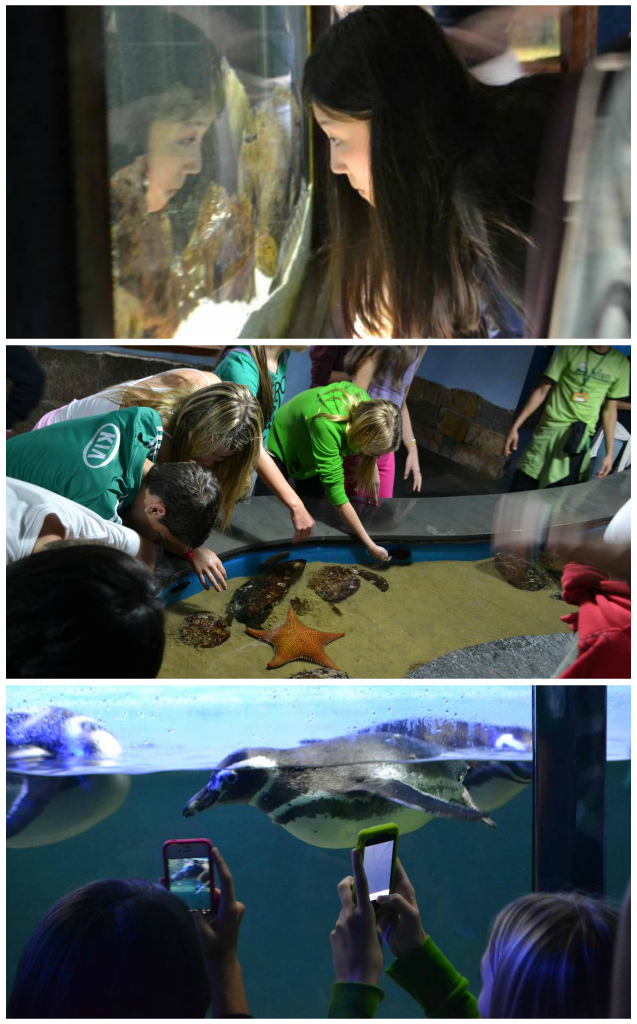
First up was a stop at Ubatuba's aquarium.  Modest in size but of good quality, the aquarium showcased the diversity in marine life in and around Brazil.  Also, there were penguins, which are not endemic, however, who is going to complain about seeing penguins?!?


The marine area around Ubatuba lays claim to being the seasonable home to four out of the five sea turtles found along Brazil's coast.  Thus, with good reason, the Projeto Tamar, a research and rehabilitation center for sea turtles, in located here.


On the second day we hopped on a boat and headed across the water to one of the many islands that speckle this part of the coastline.  Ilha Anchieta - now a State Park - was once a prison that is famous for a (almost) successful mass escape attempt.  (Side note: since I've been in this country, I have now visited a total of three shuttered prisons, two on islands.)

Sometime during the mid-1900's, the prisoners devised a plan to earn the guards' trust by essential being really, really well-behaved.  It took two years, but they eventually got to a point where they were essentially seen as a non-threat.  The prisoners, now trusted companions to the guards, waited for the day the scheduled supply boat would come to the island to turn on the guards.  They killed who they needed to then went to the dock to wait, but the ship was late due to unfriendly seas, leading the prisoners to get nervous and restless, ending with what amounted to a bloody massacre amongst themselves on the beach.  When the supply ship arrived, the prisoners who were left boarded and subsequently crashed/sank/overturned near the mainland, thus drowning most of those remaining.


Even though the island is only about 500m away from the mainland at its narrowest point, the guards had convinced the inmates that the waters were infested with sharks by occasionally placing shark skeletons and skulls on the beach as "proof." Due mostly to the embarrassment of the escape incident itself, along with the damage incurred from the beach riot, which also involved setting fire to many of the buildings, the prison was immediately and permanently shut down.

Listening to the history of the prison.
Now a protected State Park, the island is a unique preserved example of a unique ecosystem, the Mata Atlântica (Altantic Tropical Forest), that once covered much of the Brazilian coast and is now mostly limited to the stretch between Rio de Janeiro and just north of the city of São Paulo.  A few hours of hiking the island's trails, visiting a few beaches, snorkeling, and poking around in the tide pools, we were all exhausted and ready to head back to the boat.

Island flora and fauna: flower (top), vulture tracks on the beach (middle),
and Spanish moss dangling from a tree (bottom).
This is a beautiful area of the country - rich in nature, culture, and history.  I hope to be able to return in the near future to explore more of this coast, including Ilhabela and Paraty, perhaps with a little more beach beach time and a little less chaperoning!

Looking down the dock toward the mainland from Ilha Anchieta.