Showing posts with label Campinas. Show all posts

13 June, 2014

We Are One (Part I)

Meet Fuleco. Armadillos like soccer.
The lead up to the world's biggest single sporting event, the FIFA World Cup, has not been an easy one.  Stadiums aren't totally as finished as they should be.  There have been accusations of corruption (both by the Brazilian government and FIFA itself).  On top of all that, the Pitbull-Jennifer Lopez-Cláudia Leitte official anthem is terrible.

Nevertheless, the show must go on and the world is ready!

My friends from university, Dan and Alissa of This World Rocks fame, are traveling with me throughout the next few weeks.  We started the celebration off here in Campinas at Seu Vidotti, a bar holding a special viewing party for the inaugural Brazil vs. Coatia match.  Thankfully the home country emerged victorious and the party continued on a positive note!

We had our iPhones, but the photos from the bar tell a better story:

Curtindo a Copa com amigos velhos e novos!
Enjoying the Cup with old and new friends!

We're keeping a tally of the number of times Alissa (center) gets mistaken
for being Brazilian.  We may lose count...

23 May, 2014

Soccer and Symphony

While at times I feel I am lacking in general activities of any and all type, this week was an indulgence by comparison.  On Tuesday, I attended my first Brazilian futebol (soccer) match and on Thursday I visited the Sala São Paulo to hear the São Paulo Symphony Orchestra (OSESP) play.


The soccer game was hosted by one of Campinas' two professional teams, Ponte Preta.  Brazil has several leagues which move after each season, depending on the teams' standings.  (The worst two teams go down a league and the best two move up.)  While Ponte Preta holds the honor of being one of the oldest clubs in Brazil, they have never won a championship and, historically, have resided in the lowest league.  Recently, however, they have had some successes and are busting out of their "loser" reputation.


"The most loved monkey in all Brazil"

Lovingly called the "macacas" (monkeys), their fans are loyal and animated. With fans dressed in the requisite black and white, the stadium was decently full for a Tuesday night game, which the home team won, 1-0.
_____________


The Orquestra Sinfônica do Estado de São Paulo (OSESP) plays in the beautiful Sala São Paulo, which was once a train depot.  One of the world's best orchestras, we had seats in the "choir" which was a uniquely situated section directly behind the musicians, prime seating to watch the conductor.

Norwegian conductor, Eivind Gullberg Jensen, leads the ensemble.

The orchestra frequently brings in top international talent, both as conductors and musicians.  This night the orchestra was conducted by Norwegian Eivind Gullberg Jensen, and performed Mozart's "The Magic Flute" (featuring Soprano, and fellow Norwegian, Mari Eriksmoen) and Sibelius' Symphony No 5 in E flat Major.

My friend and colleague, Raquel, and me took advantage of our prime seats
 with a little #selfie action before the musicians take the stage.
Having played violin in orchestras for several years, I am used to seeing the conductor, albeit with a left side profile.  It was interesting to be back in the POV of the musicians, but with different vantage and nothing to do other than listen and enjoy.

15 March, 2014

The South Will Rise Again (Part I)

Brazil is a diverse country.  This is evident in the food, music, dance, and faces of its people.  Brazil claims Portuguese, German, Italian, Lebanese, and Japanese in its melting pot of foreign immigrants.  But there was a time when a significant number of (ex) Americans were making their way to the southern hemisphere in droves.

A little known piece of history about the settling of Brazil has direct ties to the Civil War in the United States.  After the Confederates lost the battle to secede from the Union, and thus the right to keep slaves, the economy was not exactly healthy and many once comfortable families were then struggling.  In stepped Brazil, wanting to increase its own agriculture and economy by enticing new potential citizens - of the "right" color and breeding, essentially - to move and help settle Brazil.

Thus, beginning in 1866, most of these "Confederados" began settling in what is now the state of São Paulo, around the municipality of Campinas, as it was one of the few parts of the country where Catholicism was not the dominant faith.  Here Presbyterian, Pentecostal, Baptist, Episcopalian, and other Protestant communities were in abundance.  This became especially true of Santa Bárbara D'Oeste and the neighboring, appropriately named Americana, both of which still exist today.

"Nationalities of Immigrants Entering São Paulo State from 1827-1936"
The Ex-Americans would likely have been classified as "não especificados"
as many of them did not identify with the United States of America as it was.
Also, the total of Confederado immigrants was only about 10,000 people.
To oversimplify things would be to say that these Confederates were bitter about losing their right to slaves and moved to some place that still allowed them, however, most of these immigrants were too poor to afford slaves once they got here and ended up working the land themselves for wealthier land owners, though in better conditions than the existing slave workforce. Nevertheless, their presence brought increased population and progress to the area, as these new immigrants brought with them their Southern traditions and agricultural methods.  Ironically, slavery became illegal in Brazil less than twenty years from when the Confederados first arrived.

In what was once an old town jail in Santa Bárbara D'Oeste, today stands the Museu da Imigração, a small testament to the reason why the Confederate flag can still be seen in a country thousands of miles and a continent away from where it was conceived.  In fact, there is a festival* in April of each year - in the cemetery where most of these immigrants are buried, no less - celebrating the bygone antebellum days.  (Herein lies "Part II"...)

Top: A baseball team composed of Confederados and their descendants
circa 1900.  Bottom: A Confederate $2 bill. The museum had many remnants
of life, such as this, likely brought with during the migration and left in the
bottom of drawers and closets for future relatives to find.

*I highly recommend checking out the website (As a Yankee northerner - redundant? - I enjoy the "Heritage, Not Hate" part.)

17 November, 2013

Don't Be Stupid, Stupid

Sometimes not being politically correct at all times can be refreshing.  At the risk of making a huge generalizing statement, Latin American culture is good at "calling a spade a spade."  I credit this to the structure of the language - both Spanish and Portuguese are very open with the adjectives-as-nouns concept.  Sometimes this directness spills into other areas of life.

I recently visited Campinas' Bosque do Jequitiba, a park and zoo in the center of the city.  The park was beautiful; the zoo was sad.  The only not sad animals were the free-roaming agoutis (called cutia in Brazil), a rabbit-sized rodent that looks like the cross between a hamster, a deer, and a kangaroo.

But I digress.  My favorite part of the zoo was this sign:

You dumb.

Apparently there is a problem with people throwing food - and, I imagine, other objects - at/to the animals.  The sign says that "throwing objects into the cages of the animals means" several characteristic things, several of them include attributes of throwers themselves.  In terms of blunt honesty that probably wouldn't appear in the US, for example, is number one, which states that, as a thrower of objects, you "lack education."  In other words, you are uneducated.  In more other words, "you are stupid."

I do not disagree with this point.  However, I do feel there is a risk that those "lacking in education" will not (or can not) read the posting to begin with. Same goes for comprehending Number 5: "an insurmountable irrationality."  Those be some smart folk words right there.

Sigh...it's about respect, stupid!

15 September, 2013

Running with the Night

The strangest part of doing a road race at night wasn't the time of the day.  It was figuring out what to do to prepare myself, physiologically, for the timing of the event.  Normally races begin in the morning.  I think about what I should eat the night before, when to wake up, what to eat for breakfast, and the ever-important timing of bathroom/biffy trips.

Night races throw those factors for a bit of a loop. Fortunately, not one that resulted in some unfortunate incident.

The Night Run - Campinas race took place at 8pm on a Saturday, with a course that looped around my preferred running route, the large Parque Portugal, more commonly referred to as Lagoa do Taquaral (Taquaral Lake).  There were 5K and 10K options and I opted for the later.  I honestly cannot remember the last time I raced such a "short" distance, but it was fun to mix it up and nice to do it on such familiar terrain where I knew every incline and curve.

I finished with a time of 43:51 minutes for the 10K and am pretty happy with that!  This put me at 41st overall and 13th in the 30-35 age bracket. 

There was a lot of yellow going on.
The race began, as all road races do, with a significant amount of weaving until people settle in to their appropriate pace-groups.  Since the 5K racers did one lap of the park and the 10Kers did two, the pack was thinning as we got near the end of the first loop, as the runners near me were either 10K racers keeping my pace or 5K champs keeping a decent clip.  I assumed the roads would be as clear and open for the rest of the time, but as I approach the second half of the second lap - kilometer 7ish for me - I encountered an ever-thickening group of 5K...walkers.  Walkers.  This got progressively worse as we neared the finish and the weaving recommenced.

Seriously, who enters a 5K race if you're going to be walking by kilometer 3?  If this were a charity run, I get it.  But you just paid at least $40USD to walk in the dark in an ugly yellow shirt.  Really?!?  And this wasn't just a few people; this is a collective couple kilometers of weaveable people we're talking about. 

With my friend, Claudia, post-race.

Add that to the list of things I don't get about Brazil.  (Along with why the name of the race was in English.  Incidentally, in Portuguese it's pronounced "ny-chee hoon.")

Either way, it was a well-run event and I enjoyed the novelty of night racing.  I would definitely consider doing another!

I should add this to my playlist...

20 June, 2013

Scream & Shout

This post is a follow-up on a previous post regarding the growing discontent amongst Brazilians with respect to their government and the ensuing public demonstrations.


Front page news shows a woman
getting blasted with pepper spray.
Now that the international media's attention* has been caught and eyes are on Brazilians as they take to the streets ("vem pra rua"), one goal of the people has been met: getting noticed.  If protesters wanted to have their country viewed as more than soccer, beaches, and bikini bottoms, then they have succeeded.

In some ways the demands have even been met.  Or, more accurately, one demand. The original 20 centavo public bus fare price hike from the beginning of the new year has been dropped back to what it was before.  (In Campinas the hike was actually more - 30 centavos.)  But, as many protest signs and online propaganda have alluded to, it is "more than the 20 centavos."  Some have called it the literal tip of the iceberg, while others equate it to only "a drop."

Likely the government is simply attempting to pacify citizens with the removal of the fare increase, though the success of this tactic is yet to be seen.  If it truly is about "more than the 20 centavos," then the protests should continue.  If they stop, the issue - or issues - will likely become more confusing.

The #changebrazil hashtag situation has already won some
celebrity support abroad including Katy Perry, Britney
Spears, and (pictured clockwise from top left) Mark
Zuckerberg, Lady Gaga, Arnold Schwarzenegger, and
Beyoncé.  I've seen others "endorsements" that have been
obviously photoshopped.
In many ways, it already is.  Since the 20 centavos is only the iceberg's tip or one drop of the issue, many citizens have jumped on the bandwagon with their own sets of underlying causes and additional related problems.  Many Brazilians I have spoken to, who support the protests, fear that this lack of laser focus may be the movement's downfall.  What do they want?  Change.  What do they want changed?  Well...everything.

This now becomes another bigger and more complex problem.  This kind of "everything change" only comes with new government officials, which usually only comes from new political parties, and new elections.  And what do these have in common?  They all take time.

Surely more time than lowering bus fares.

Campinas holds its own protest within the hour at the Largo do Rosário in the next neighborhood over from where I live.  So, as I sit typing this now to the symphony of car horns and shouting from car windows 14 floors below me, I wonder what, if any, this continued message will say to the Brazilian powers-that-be and the rest of the world.

"2013: The year Brazil stopped screaming for goals,
and decided to scream for history."
Less Soccer Tournaments (Cups)
More Transportation, Health, and Education.

* Reports from the BBC, The Daily Beast, and The New York Times.

All images were taken off of various Instagram and Facebook postings.

24 March, 2013

The Key to Losing

They say "quitters never win."  Well, ain't that the truth.


You can't really lose a half-marathon.  You can win, sure.  Anyone who has ever crossed the finish line first can attest to that.  But you can't lose at running 21K.  You show up and finish or you don't.

You can lose your keys.

At some point just after km 3, a fellow racer tapped my shoulder and said something about dropping things.  I quickly assessed my being - ipod (check), timing chip on shoe (check), water bottles in belt (check, check), apartment key in back pocket (oh, crap).

Thus began the next fifteen minutes of retracing my steps, like a salmon against the flow of runners, eyes on the ground, asking each race official, "Perdi minha chave; você sabe algo disso?" (Loosely translated to: My dumb ass didn't zip the back pocket to my shorts and my key came flying out; have you seen it?)

I think Bruno Mars was telling me something...
On my second lap of the area where the key was mostly likely to have been lost, the third race monitor I spoke with approached me with the missing door-opening implement.  By that point the slower of the 10K racers were passing by.  Relieved, I thanked the guy and he wished me a boa prova.  "Agora, não vale a pena," I replied (It's not worth it now).

Fortunately, the course essentially wrapped around the neighborhood where I live, so I removed my conspicuous race number and walked home.  On the way I thought about how grateful I was that the gentleman in the race tapped my shoulder to let me know I dropped the key.  Obrigado, Sir!  This sentiment was short-lived, however, when I thought about the fact that this was a key.  Not a few coins, or a water bottle.  This is something people need to get into important life things, like cars and houses and safes.

So I call bullshit, Sir.  Had I been running behind someone and they unknowingly dropped a key, I would pick it up.  This was km 3, after all.  You have not hit your wall; your brain is still functional for logical thinking.  A considerate person picks that shit up.  I'm just saying.

I'm not passing the blame here - I should have triple-check the zipper on the pocket - I'm just disappointed.  It was a good three kilometers, though...

Race Swagg
What amounts to the most expensive bottle of sunscreen ever.

02 March, 2013

Street Food

Every Saturday a few blocks of a street in my neighborhood, Rua Maria Monteiro, gets blocked off and filled with vendors selling all sorts of produce and other goods, reminiscent of a Farmer's Market.  I try and go a couple times a month but sometimes Saturday mornings are for sleeping and hammocking with a cup of coffee rather than venturing into the civilized world.  Still, I've been meaning to play with my camera, and I decided today was the day:


14 December, 2012

Drip Drip Drop (Part II)

Arctic tundra and tropical rainforest.  A mule and a bullet train.  E. coli and an elephant.  Frogger and...whatever it is my students are playing now.  Opposites.  Our privileged, well-funded school abuts one of Campinas' ghettos, or favellas.  There is a wall, however the members of this community - composed of rows of ply-wood and aluminum roofed homes and littered with abandoned  tire-less cars - know the societal level that attend the school; they hear the soccer games and playground squeals.  Some who happen to live in sturdier, two-story housing can even catch a glimpse of our students eating in the cantina and walking carefree to class along the beautifully green landscaping and manicured cobble-stone paths.

For embarrassment's sake, let's called it "awhile ago."  Awhile ago I wrote about a conference held in São Paulo for student social awareness clubs and groups called the Global Issues Network (GIN).  The students I co-sponsor in this Rotary-supported group - called SEED Club - presented a literacy program they have enacted in the Guaraçai favella behind the wall of our school.


A building exists, and in years past, it has been filled with shelves and donated books; computers with games; chairs, soft foot-stools, a plush reading chair, and other comfort-creating spaces; as well as a craft/activity room.  The students found it difficult to get the children of Guaraçai to become engaged in the "library" part of the building.  Thus was borne the idea of a reading incentive program.

The students created a secure check-out system with reward points for borrowing and returning books.  They also, with the help of the local Rotary club, took a story-telling workshop which has enabled them to better interact with the kids in the community in terms of literacy when we visit every Monday and Friday after the last bell rings for the day.

Below are a few pictures taken by a mother who has volunteered a lot of time getting donations, physical and monetary - from various multi-nationals as well as simple cataloguing of the books themselves.  At the end of the day, though, the students do a phenomenal job of running the show and doing their small part to be a positive influence on these children's lives.

A couple of high school girls help the community kids craft with clay.

A girl from the community browsed the stacks.

One of the senior club member teaches a couple
community girls how to play Twister

*All photographs by M. Burrows (c) 2012

26 September, 2012

Forecast: Frio

In 6th grade science we are studying changes of states of matter.  I hit my own freezing point today.

Supposedly, spring began last week.  That was the word on the street sometime last week.  I didn't take much notice as to the exact date as the end of "winter" was fairly pleasant with cool mornings, crystal-clear blue and sunny skies all day, and a nice gentle breeze in the evenings.  I felt more of the same was on the horizon.

Last week was close to 35˚C (around 95˚F) and humid.  The air-conditioning in my classroom broke and I found out the nice evening breeze doesn't blow straight into my apartment, but parallel to it.  I slept on top of the covers with the ceiling fan on high.

Then today this happened:


I wore my jacket all day long.  And I wished the entire time I also had a sweater.  Now I know I am shaming my Minnesota roots with this admission of meteorologic weakness, however, 55˚F is not warm.  After being free of the hardy mid-west winters for over five years and adjusted to the eternally summer heat of Cali, I would not have snubbed my nose at a parka today.

So, is this a freak event?  According to the forecast, Campinas will have to endure one more day of this:


You know its a bad sign when the temperature color gradient only goes from frio (cold) to mais frio (colder).

The weather was so ridiculous the other night between intermittent splashes of rain and the whistling, whipping wind - my window shutters on the 14th floor woke me up at 4:30am - you would have thought a hurricane was-a-comin' were Campinas not a good 96 km inland.

Found this posted on Facebook during the deep freeze.
Title: "Temperature of the Day in Campinas"
Switch Settings: Alaskan Cold, Tornado Wind, Hard Rain
and Desert Heat
I know its getting colder in the northern hemisphere, but down here on the flip-side of the equator I feel it should be going the other way.  Come June when the school year is coming to a close and winter is setting in, I will be happy to escape to the warm Minnesota summer sun.

I don't feel its too much to ask for Brazil to get its seasons straight.  Or reversed.  Or whatever they're supposed to be down here!

07 September, 2012

190 Candles

In the city of Campinas, the morning of September 7th would be a great day to rob a house and a terrible day to have a power outage or a heart attack.

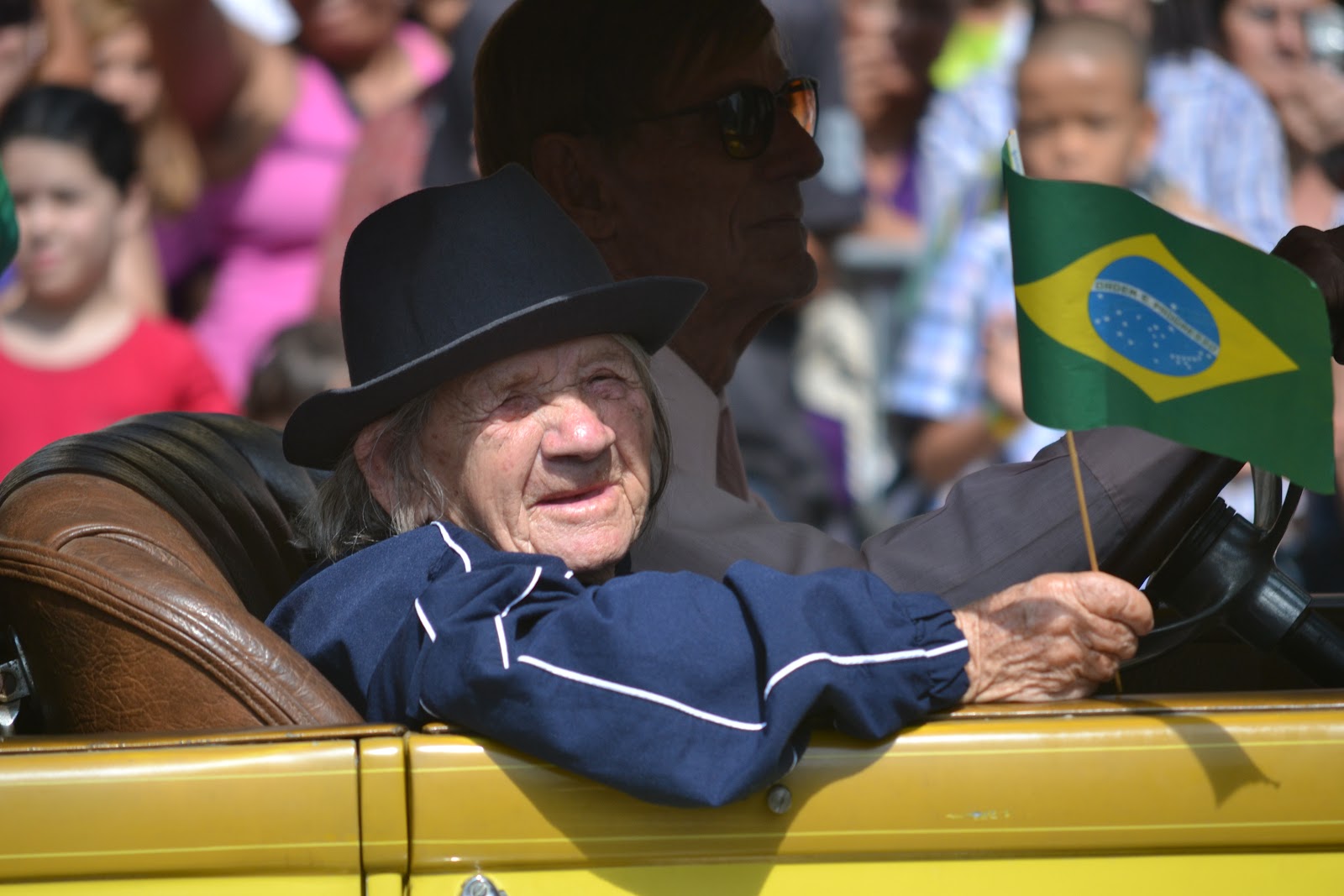
That's because every single one of the city's police, medical workers, ambulances, utility trucks, and even school busses are making their way down the Independence Day parade route.  And based on this experience, Campinas does overkill well.


After a long delayed start, the parade began with a proverbial flexing of the muscles that every country is allowed to do on their country's birthday.  Every branch and regiment of the military and municipal police force marched down the street in full dress, lead by the (very good) Military Band.  This includes bike cops, police dogs, and ambulance drivers among others.


Then we all waited some more and along came the corps of public employees.  This being a national day off from work, I'm sure they were all thrilled to have to marching down the street waving at all those they service.  The crowning moment - after all the power, gas, and electric workers and their vehicles passed by - was the parade of never-ending school-busses.  

Arguably the worst part of the parade for all the kids trying to enjoy
their day off of school.
Now, I could be wrong, being that my Portuguese is still "developing," but I think these may have been new busses for the city's schools and this was their grand premier.  The crowd's excitement was moderate at the beginning and faded exponentially with each subsequent vehicle.

There was yet another long mysterious break, at which point various marching bands and city-wide organizations had their moment in the pavement.  I tried to use today as a practice session for future processional-like events I may want to photograph, such as Carnival, however, I may need a few more practices; parades are surprisingly challenging to photograph well.  Regardless, here are a few shots from the rest of the event:


I'm pretty certain this is the Campinas chapter of the Harry Potter Alliance.
But I don't speak Portuguese so I could be wrong.

Happy 190th Birthday, Brazil!

10 August, 2012

Sites Seen

I'm going to be head-over-heels busy this year so fortunately/unfortunately my new city has little to offer in terms of true tourist draws.

Bem-vindo á Campinas!
Notice the churrascaria at the bottom?  Brazilians love their meat!

Jockey Club building.
It is located in the Centro district near some popular night spots and
a plaza with a statue in honor of Carlos Gomes, a famous opera
composer from the 1800's and native son to the city.
Also, it is blue.

The Municipal Market: a good place to get fresh produce, meats, and
other possibly off-the-back-of-a-truck consumer items.

Officially known as Parque Portugal, most residents
call it Taquaral, after the lake at the center.  This is a
good-sized park, which I have adopted as my main
running area.  Nice wide dirt paths around the lake,
coupled with good lighting at night and lots of
fellow runners, makes this a great place to work out.
There are also swan paddle boats (seen pictured at
the lower left) as well as caged peacocks and herds
 of loose feral cats (not pictured).

And that basically concludes the city tour!   There are several sites of interest a short drive outside Campinas, but there is a clear reason the city appears no where in the most recent edition of The Lonely Planet: Brazil.

Regardless, I am living in one of the more interesting and vibrant neighborhoods, full of boutiques, cafés, bakeries, markets, restaurants - Japanese, Argentine, Italian, German - and parks, so having an interesting social life is within walking distance at all times.

Stay tuned...