13 February, 2013

Sensory Overload

I wouldn't be surprised to learn there was no word in Brazilian Portuguese for "subtlety."  Seems size is not the only thing big about Brazil.  It's not enough it has the largest city in the Americas (São Paulo) and six in the top 15 for the two continents together, it also has the largest Japanese population outside of Japan. The Amazon may not be longest river in the world - it's the second - but it is number one for the highest volume and watershed. And aside from throwing the world's largest New Years Eve party, it also has Carnival.

In my travels I have had many "I'm going to appreciate this more later" moments.  The times when you are in a situation, seeing something incredible, or attending an event, all the while appreciating it, but knowing that the experience will only become richer with time. Attending Carnaval in Rio, specifically the iconic parade at the Samba-drome, was one of those rare and treasured moments.

My friend Ebony and I getting into the Carnaval spirit!

To many people outside of the country, the words Carnival and Brazil seem to be synonymous.  The days-long celebration of excess leading up to Ash Wednesday is a sight to behold.  The main attraction - the parade event - is held in a permanent stadium-like structure called the Sambadrome.  It is about three long city blocks in length with stadium seating on both sides.  For $US100 and up, you can get spot in the bleachers and forgo a night in a hotel, as the parade begins around 9pm and runs until nearly sunrise, with numerous Samba schools marching down the "street" between the facing stands.

Rio's Sambadrómo or the Avenida Marquês de Sapucaí.
Our "sector" was only about halfway down the entire route.

The lights, the sounds, the songs, the costumes, floats, and feathers all make for a visually stimulating night, however, in the end, this is a competition.  Groups are awarded points for various aspects of their "performance" - costuming, overall theme and concept, percussion section, etc. - and penalized for others, namely time.  The route is long and the planning has taken over a year, but it is still necessary to get your entire crew down the parade route in under 90 minutes.  They have an hour and half?!? you might ask.  Yep, and some still end up taking longer!  The floats are not race cars and you can only move so fast in stilettos and fifty pounds of feathers and headdresses.

I could describe the parade to you all night long (pun intended) but I'll let the pictures speak for themselves...

The first group chose "Telenovelas" as their theme.
This is a close-up of a float dedicated to the evening soap "Que rei sou eu?"
This is the top of float representing a plantation house from a soap set during
the slave era.  I don't know much about it, though it's usually on while I'm at
the gym and it seems the slaves and slave owners had a lot of sexual tension
between them if the sound off, subtitles on are any indication.
Also, yes, that is a whipping post.  At this point the master was taking a break
from the mimed infliction of corporal punishment.
I know nothing about this one except it's awesome.
Every group had a lady spinning around in a large dress with a flag
accompanied by a matching male escort.  The second group's theme represented
the city of Cuiabá, the capital of Mato Grosso state, one of the country's largest
and most "jungly" areas.


There was a lot of pink and green going on here.  This represented a typical,
though neonified, version of a tropical urban dwelling replete with jazzy
faux corrugated tin roofs. 
A close-up of the same float shows how many resembled mini-stage-like sets.
We thought these were supposed to be birds, but what do we know?!?
There was clearly a lot of folklore worked into this theme. 
Welcome to the jungle!  There is a lot going on here!
An intense float with a snake emerging from the water.
A close-up of the same float.  The designers and engineers do the best they
can to disguise the handles the performers hold on to for stability.
Mythical jungle monsters?  Cavemen?  Yetis?  Who knows!?!
Amazing?  Definitely.
The costumes seemed to get more and more elaborate.
these appear to represent ghost ships of sorts.
Jungle flora and fauna
Parrots and Crocodiles
Of course the snakes are carrying soccer balls. 
Sometimes it was difficult to differentiate between the costume and the wearer.
What people; I just see frogs and leaves here!
Enlarge this (click on it) and count the people.  I dare you.
(Also, that's real running water coming out of the soccer ball waterfall.)
Each group had a percussion section, easily the best part of the parades.
The third group's theme had something to do with horses, however, "hot mess"
may have been a more accurate title.
Evidently, I was less impressed with them as I have the fewest pictures.
These were cool costumes, though.
When watching on television the commentators can tell you who the people
are, if they're important.  This guy was probably important. 
On the more impressive floats in the third group, it had Tiffany-style laps
and swinging lanterns.  It's about 1:30am at this point.

The fourth group was my favorite as far as overall artistic concept goes;
though not necessarily its actuality.
Recently, oil has been discovered off the coast of Rio and there has been
dispute within the country who should/will benefit from it, economically.
This group's theme seemed to be a celebration of ouro negro or "black gold."
Here they are doing their own "Grease Lightning" choreography.
What's a theme about oil with rigs and swinging oil workers?!?
This was a spectacle: oil industrialization at its finest.
Those are giant gas pumps coming off the front of the float.
And lots of dancing gas pumps bringing up the rear.
Apparently oil money will enhance the arts...? 
And let's not forget construction and urban infrastructure.

At this point my camera battery died.  (If you think this was a lot of pictures, you should see the hundreds I pared down from for this post!)  Hopefully I can post more from other's cameras.  This last one is from my phone and was the ending float for the oil-themed group.

The piece de resistance: beginning with a neon iguana, floating jelly fish, and a magically
marine-like ferris wheel, the float suddenly turns apocalyptic on its back section, resembling
an oil spill.  There were even performers dressed in one long connective black sheet that was
eerily accurate in its portrayal of an oil slick on the water; you can see them in the top left corner.

I did end up making it to the end around 5:30am and it was worth every overdone second.  Thank goodness the subways were running all night!  Go big or go home, right?  More like: Go big and then go home. 

02 January, 2013

Rio's Réveillon

13 Things I Loved About Rio At New Years

Happy 2013 from Rio de Janeiro!  Better yet...feliz ano novo!

To say Rio is crazy during the end the year would be the understatement of the year.  Many bucket-listers put a visit to Brazil's iconic city as a must-do.  In honor of the experience and to ring in the New Year, I present 13 favorites from my week here:

1 - "Take You To Rio"  In full-disclosure, I admit this song is terrible.  Rhyming "Rio" with both "eagle" and "gazebo" may be one of the more ludicrous moments in songwriting history, not to mention the fact that Rio is known for neither eagles or gazebos.  Regardless, this song, from the animated film Rio, is catchy and we may have played it in our rental apartment at least once a day.  (I put this song first so that you can play it while reading.)


2 - Réveillon From the French word referring to a "long dinner", in Brazil it is appropriately used to describe New Year's Eve.  Imagine throwing a party for around three million people (last official count, anyway).  Rio does it successfully and with seeming ease every year, and that's not counting Carnival.

Streets and Avenues several blocks from the shore are closed as dusk approaches, people begin showing up to the Copacabana expanse of beach around dusk dressed in white, and all along the sand are huge stages set up with free concerts all night long until about 3am.

At midnight the masses direct their attention toward the bay where a spectacular fireworks display rings in the first minutes of the calendar change.  Shortly afterwards people make their way a few more paces to the actual surf and hop or leap over the first seven waves as they come in.  Other bring flowers and toss them into the Atlantic as a symbolic offering to Iemanjá, an indigenous sea goddess.

One of the pre-fireworks shows: Baby Consuelo do Brasil
Like a Brazilian cross between Lady Gaga and Cher?
Feliz ano novo!
Jumping over the first seven waves of the new year.  When in Rome Rio...

3 - Underwear  Since so many revelers are heading into the sea at midnight wearing white, it has become important to consider what color underwear one is sporting underneath.  For this reason, Brazilians have determined that the wearing of certain colors serves as a sort of wish or destiny for your coming year.

I wore light blue: here comes some "tranquility and health" in 2013!

The iconic wave-like mosaic pattern of Copacabana.
4 - Jogging Copacapana I did not stay out late with the rest of the crazies for Reveillon.  After the fireworks, we wandered the ocean-front drive until that distinct moment of the night when girls that spent hours getting ready go from "runway" to "rundown" and a rolled ankle in the wrong direction can lead to pavement cage-match brawl between 'roided out strangers.  The line between show-stopper and shit-show in paper thin and sneaky; blink and its there.  That's my 31 year old cue to call it a night.

My 31 year old morning cue, however, was to go for a run down the mostly cleared out Copacabana beach front, made famous for its unique mosaic pattern, which has come to be another symbol of Rio.  Dodging the myriad orange-suited sanitation workers and a handful of marathon partiers - who looked more like they had just been dropped off my aliens in a strange new land than the sentient beings they likely were twelve hours before - I had a more or less clear path to enjoy the morning sun and the expansive sidewalks, starting out the year with some calm and cardio, much like my underwear foretold.

Not to be outdone, Ipanema has its own pattern, though not as famous.

5 - Morning-after Infrastructure  While running I was supremely impressed by the coordinated efficiency with which the city's trash workers and favela citizens worked to return the streets to their prior shine.  Choreographed as if by habit, there seemed to be an unspoken allowance that the sanitation workers acquiesced to those from the slums to collect heaping mounds of black garbage bags filled to the seams with aluminum cans and glass beer and champagne bottles, while they snaked slowly behind, like a trail of bright orange ants following the curbs, sweeping whatever else constituted un-beach-like debris.

I was impressed.  By 9am you would have been hard-pressed to find physical evidence of the spectacle that took place the night before, save for the still-standing stages in the sand.

Ipanema's Posto 9
6 - Posto 9  Our go-to location along the Ipanema Beach.  This is supposedly the beach to see and be seen.  It is also the beach closest to the bar where, in the 1960's, bossa nova musicians Tom Jobim and Vinícius de Moraes penned the now world-famous "The Girl From Ipanema."

7 - Beach chairs & Umbrellas  Every place around the globe known for its beaches has its own "beach culture."  In Rio, aside from speedos and thongs on full display on and off the sand, it's umbrellas as far as the eye can see.  During the peak of the day it appears as if you could walk from one end of the beach to the other across the tops of the thousands of multi-colored domes. All along the shore are tents renting folding beach chairs and umbrellas for as little as $5 USD a day.  You may not get strange looks for having a G-string but you might if you're the one lounging flat on the sand on a beach towel!


Ipanema & Leblon Beaches in all their holiday glory.
Need a new bikini top?  Vendors have you covered, literally.
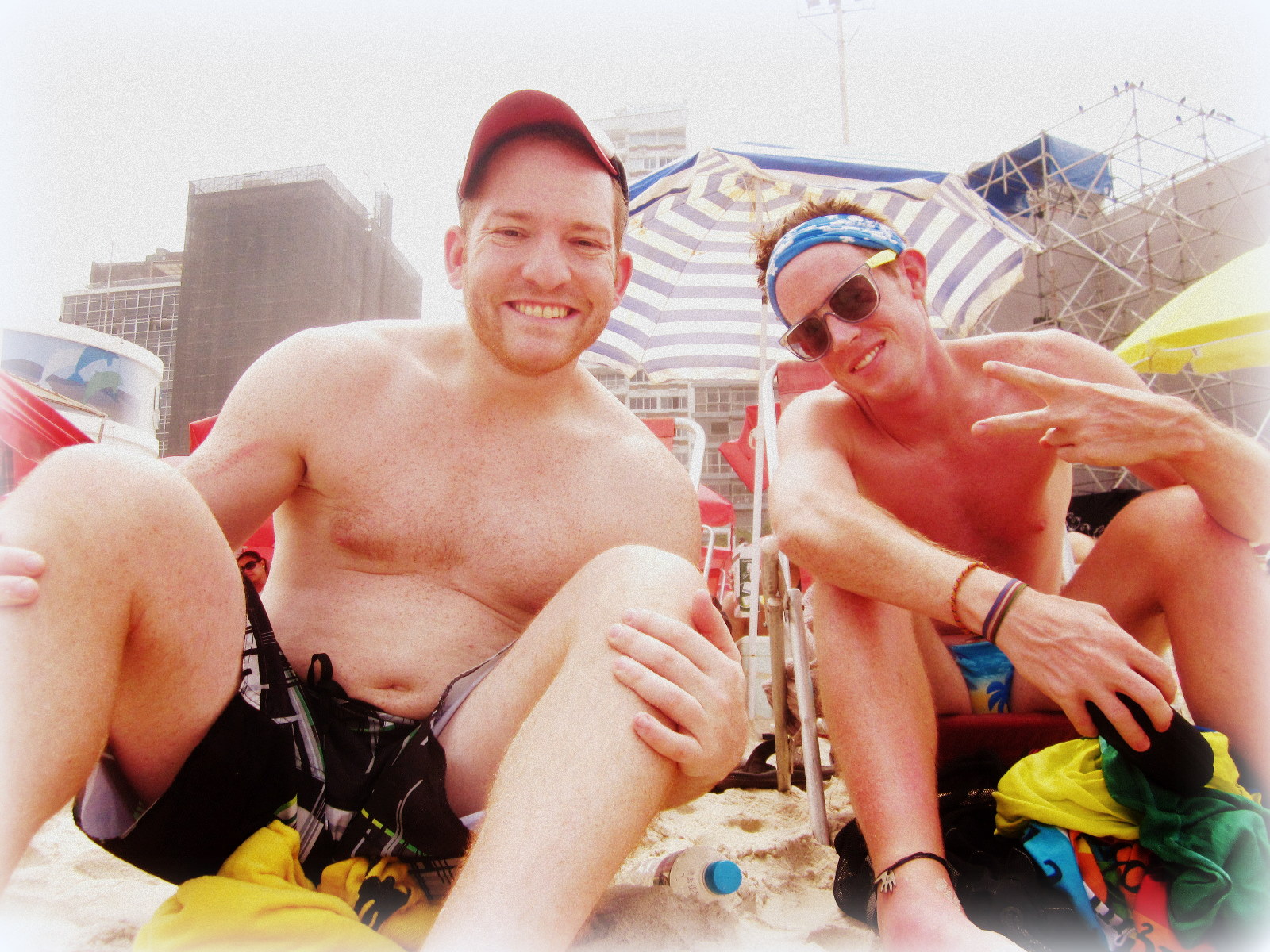
WARNING: Gingers on the beach.  May cause blindness.


8 - Açai à praia Açai is a delicious fruit popular in Brazil.  It is made into a juice, often augmented with blended bananas or strawberries and topped with granola.  It somehow becomes infinitely more tasty when consumed on the sand under the shade of an umbrella.

9 - Barraca do Uruguay Sandwiches Food Network personality and chef Anthony Bourdain visited this sandwich shop smack in the middle of Ipanema Beach near Posto 9.  (In the video below, skip ahead to the 5 minute mark.)  Marked by the Uruguayan flag - because the stand's owner is named "Uruguay" and not because the sandwiches themselves have anything to do with the country in the least - if you are anywhere near this stand at lunch time and do not eat here, you should be deported.


What else do you need?


10 - Jardim Botânico With over 8,000 plant species, some birds and monkeys for good measure, Rio's botanical gardens have been around since 1808 in a beautiful and expansive location a short taxi ride from the beaches.  A refreshing stroll beneath towering palm trees and winding paths, the gardens offer up a nice break from the heat and human density of the shore.


Clockwise top right: heron statue, red tree flowers, tiny monkey, waxy leaf
in the Japanese Garden, fountain, pitcher plants

11 - Pastels  Deep-fried doughy pockets of goodness.  The bakery on the corner, dangerously near our temporary abode, served up some of the best I've had since coming to Brazil.


12 - Centro walking tour Thanks to the Lonely Planet, we took a Saturday afternoon to do a self-guided walking tour of the historic Centro district of Rio.  Many colonial and baroque churches and palaces dating to the 1700 and 1800's dot this neighborhood, mingling with modern buildings and skyscrapers.  

Typical façades along Rua da Carioca in Centro.

One of the highlights was the very modern Catedral Metropolitana which, built in the 1970's, resembles a Mayan space ship.  From the inside, however, four wide strips of stained glass line the sides at ninety degree angles beginning 60m above the circular pulpit; inside, due to this shape, the cathedral can sit about 20,000 worshippers.


Statue in silhouette at one of the cathedral doors.
Paço Imperial (Imperial Palace) built in 1743.
Looking across the Praça Floriano at the Theatro Municipal, built in 1905.

13 - Pão de Açúcar Some cities have skylines recognizable by their buildings' collective cut-out imprint on the blue/smoggy expanse above them.  Rio is recognizable from a distance by its hills, specifically the Pão de Açúcar.  We hit up the "Sugar Loaf," as the steeply mounded hill is known, first thing in the morning to avoid the mess of inevitable tourists we encountered at Cristo Redentor (Christ the Redeemer) earlier in the week.  (Also note that the mountaintop Jesus is not on this list, partially for that reason.)

Accessed by cable-car, from atop the Pão de Açúcar a view of Rio is laid out before you like none other, even from the aforementioned Christ statue.  We could see Rio's main harbor, Copacabana and Leme Beaches, the Centro district, and the rollings hills that the city seems to be nestled into.

Obrigado, Rio!
Rio treated us well for Réveillon and I expect nothing less in February when I head back for Carnival, Rio's other big party...

26 December, 2012

Rio Prep

I've been told no one does New Years Eve better than Rio de Janeiro.  We shall see.  For me, I've learned from experience over the years that this holiday is possibly one if the most over-rated of events.  Rio has a potential to change my mind, though I am purposefully setting my expectations to "lukewarm anticipation" in preparation.

Also in preparation for spending a week in this world-famous city, I watched a couple films.  The first was the award-winning Brazilian film City of God (Cidade de Deus) about the violent inner-workings of a large favela during the 1960's and 70's.  The second is the animated Rio, about a domesticated blue macaw from Minnesota (hey!) who ends up in the titular city and learns how to fly, literally and figuratively.


Based on these two movies - which were both great for different reasons - here is what I know and expect from my trip:
  • All birds speak English. (Rio)
  • Guns are as common as grains of sand and just as easy to acquire. (City of God)
  • Your camera will not get jacked if you are friends with a slum lord. (City of God)
  • Small break-dancing monkeys will steal from tourists at the Sugar Loaf. (Rio)
  • Small children from the favela ("runts") will steal your pot at the beach. (City of God)
  • I guess Minnesotans say "Cheese and sprinkles!" when we're exasperated.  So I should practice that. (Rio)
  • Small birds with bottle caps for hats are totally legit. (Rio)
  • Cocaine-addicted gingers are not to be trusted. (City of God) Probably all gingers as a general rule...
  • Being a chicken is a dangerous station to have in life. (Both)
  • Favelas are bad places filled with shady gangs who kill indiscriminately...and may deal in the illegal bird trade. (Both)
  • The beach is an awesome place. (Both)
  • Everyone loves samba - birds and ghetto thugs alike. (Both)
So, based on this information, off to Rio I go...Feliz Ano Novo!!!

23 December, 2012

Meet Me Halfway

Approximately six months ago I started a self-imposed challenge to read one book a week for an entire year.  Today marks the end of week twenty-six.  Halfway.  

It is not easy and I am not always on schedule, but I am still in the game.  And I have come across some great reads.  If you have any suggestions for where I should go from here, I would love them.  I do have a list, my Kindle, and few lent "real" books, but recommendations are always welcome!

Go Big Or Go Home

This is a capybara.


I often see them on some of my runs.
It may look cute, but they're really possibly the weirdest creature on the planet.  
Like a guinea pig you can ride.  


Capybara's are the world's largest rodents.  They can grow to be a little over 4ft in length and 2 ft tall.  One source I found claims they can weigh up to 170lbs!  

Makes me wonder why Ecuadorians waste their time eating those tiny little normal guinea pigs when they could throw one of these suckers on the spit and feed a small village?!?  
(Actually, Capybaras are eaten in Venezuela...but just for Easter.)

Capybaras live in groups, graze like cows and geese, eat their own feces, and can do this:


They swim.  A giant swimming guinea pig.  Awesome.
I think I'll stick to the running trails.

14 December, 2012

Drip Drip Drop (Part II)

Arctic tundra and tropical rainforest.  A mule and a bullet train.  E. coli and an elephant.  Frogger and...whatever it is my students are playing now.  Opposites.  Our privileged, well-funded school abuts one of Campinas' ghettos, or favellas.  There is a wall, however the members of this community - composed of rows of ply-wood and aluminum roofed homes and littered with abandoned  tire-less cars - know the societal level that attend the school; they hear the soccer games and playground squeals.  Some who happen to live in sturdier, two-story housing can even catch a glimpse of our students eating in the cantina and walking carefree to class along the beautifully green landscaping and manicured cobble-stone paths.

For embarrassment's sake, let's called it "awhile ago."  Awhile ago I wrote about a conference held in São Paulo for student social awareness clubs and groups called the Global Issues Network (GIN).  The students I co-sponsor in this Rotary-supported group - called SEED Club - presented a literacy program they have enacted in the Guaraçai favella behind the wall of our school.


A building exists, and in years past, it has been filled with shelves and donated books; computers with games; chairs, soft foot-stools, a plush reading chair, and other comfort-creating spaces; as well as a craft/activity room.  The students found it difficult to get the children of Guaraçai to become engaged in the "library" part of the building.  Thus was borne the idea of a reading incentive program.

The students created a secure check-out system with reward points for borrowing and returning books.  They also, with the help of the local Rotary club, took a story-telling workshop which has enabled them to better interact with the kids in the community in terms of literacy when we visit every Monday and Friday after the last bell rings for the day.

Below are a few pictures taken by a mother who has volunteered a lot of time getting donations, physical and monetary - from various multi-nationals as well as simple cataloguing of the books themselves.  At the end of the day, though, the students do a phenomenal job of running the show and doing their small part to be a positive influence on these children's lives.

A couple of high school girls help the community kids craft with clay.

A girl from the community browsed the stacks.

One of the senior club member teaches a couple
community girls how to play Twister

*All photographs by M. Burrows (c) 2012