Showing posts with label volunteering. Show all posts

14 December, 2012

Drip Drip Drop (Part II)

Arctic tundra and tropical rainforest.  A mule and a bullet train.  E. coli and an elephant.  Frogger and...whatever it is my students are playing now.  Opposites.  Our privileged, well-funded school abuts one of Campinas' ghettos, or favellas.  There is a wall, however the members of this community - composed of rows of ply-wood and aluminum roofed homes and littered with abandoned  tire-less cars - know the societal level that attend the school; they hear the soccer games and playground squeals.  Some who happen to live in sturdier, two-story housing can even catch a glimpse of our students eating in the cantina and walking carefree to class along the beautifully green landscaping and manicured cobble-stone paths.

For embarrassment's sake, let's called it "awhile ago."  Awhile ago I wrote about a conference held in São Paulo for student social awareness clubs and groups called the Global Issues Network (GIN).  The students I co-sponsor in this Rotary-supported group - called SEED Club - presented a literacy program they have enacted in the Guaraçai favella behind the wall of our school.


A building exists, and in years past, it has been filled with shelves and donated books; computers with games; chairs, soft foot-stools, a plush reading chair, and other comfort-creating spaces; as well as a craft/activity room.  The students found it difficult to get the children of Guaraçai to become engaged in the "library" part of the building.  Thus was borne the idea of a reading incentive program.

The students created a secure check-out system with reward points for borrowing and returning books.  They also, with the help of the local Rotary club, took a story-telling workshop which has enabled them to better interact with the kids in the community in terms of literacy when we visit every Monday and Friday after the last bell rings for the day.

Below are a few pictures taken by a mother who has volunteered a lot of time getting donations, physical and monetary - from various multi-nationals as well as simple cataloguing of the books themselves.  At the end of the day, though, the students do a phenomenal job of running the show and doing their small part to be a positive influence on these children's lives.

A couple of high school girls help the community kids craft with clay.

A girl from the community browsed the stacks.

One of the senior club member teaches a couple
community girls how to play Twister

*All photographs by M. Burrows (c) 2012

13 October, 2012

Drip Drip Drop (Part I)

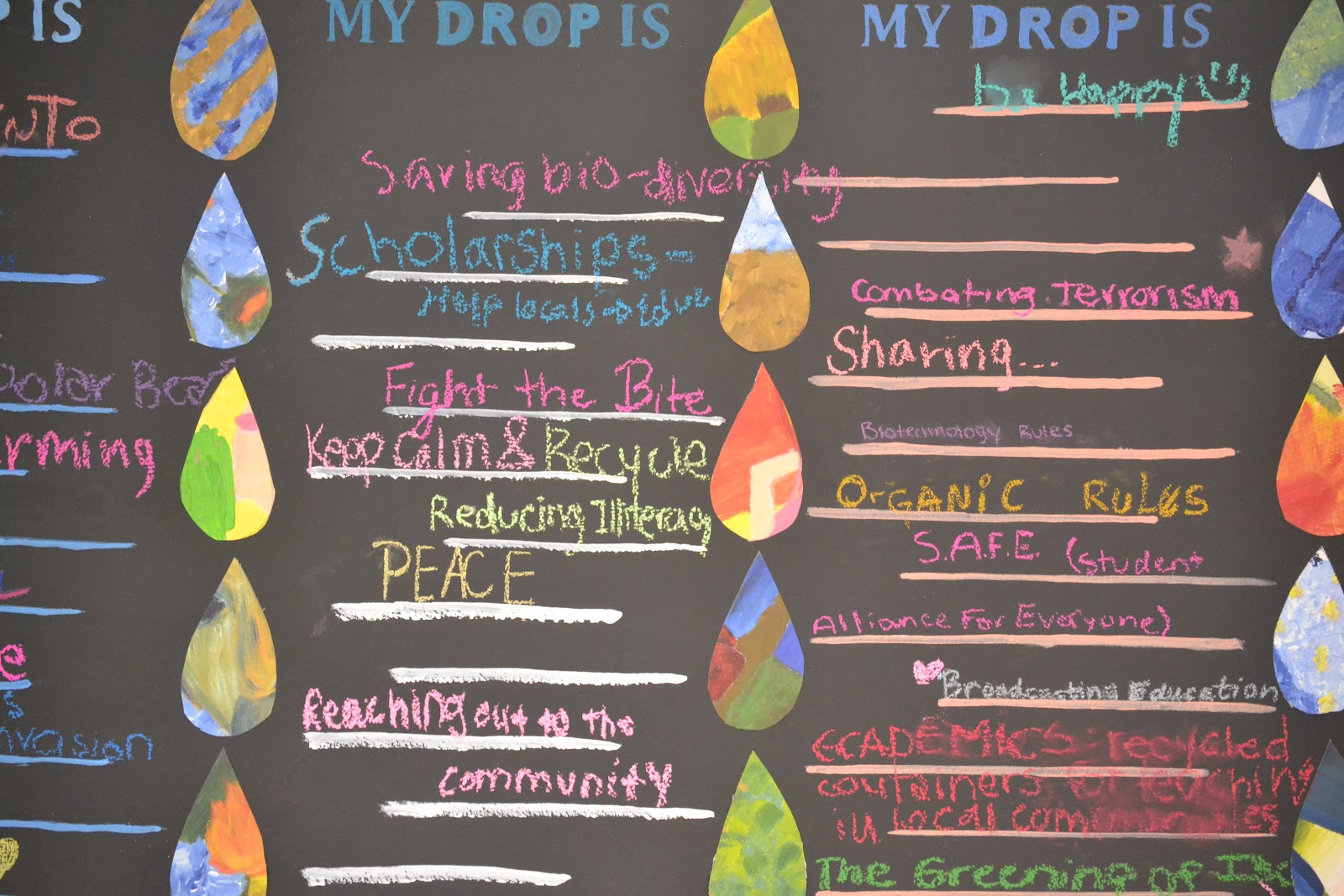
An old fable that tells how, when the forest was burning and all the animals stood around watching, the tiny hummingbird flew back and forth from the river to the fire throwing one drop of water on it at a time.  When the other animals asked how the hummingbird thought it could actually make a difference, he replied, "It's the best I can do."  Thus was borne the theme of this year's GIN of the America's Conference.

The idea of the GIN Conference (Global Issues Network) is a student-led forum focusing on environmental and social topics, which is held around the world.  The conference is new to South America - this is only the second annual event here - but has been present and immensely successful annually in other continents including Asia, Africa, Europe, and North America for many years.

This year's conference was hosted by another American international school a short drive away in São Paulo and included schools from Brazil, Peru, Venezuela, Ecuador, Uruguay, Argentina, Costa Rica, the Dominican Republic, and even my old school in Colombia.


Throughout the three days students heard numerous keynote speakers on a variety of topics, many young eco-entreprenuers, as well as attended workshops presented by their peers on various projects, campaigns, and initiatives they have been working on at their respective schools.

It was impressive and inspiring to here the work and successes of students working to end malaria, create sustainable recycling programs in poor neighborhoods, and increase technological literacy for orphans, among many other projects.  Anyone who thinks the world's youth is on downward spiral needs to attend a GIN Conference to see otherwise.

Keynote speaker Bruno Massote, current president of Terracycle in Brazil,
talks about the concept of "eco-capitalism."  He's 29 years old.
One of my students presenting on improving literacy
of favila children through story-telling workshops.
Students from Venezuela discussing their project of recycling & reformatting
computers for use in teaching necessary basic computer skills to orphans
living in poverty in their city of Maracaibo.


Coming soon: Drip Drip Drop (Part II) will include profiles of projects the students I advise are working on.