30 May, 2013

More Than Fun To Say

I admittedly have not gotten to travel much during the last ten months living in Brazil, something I hope to remedy in the next year.  Regardless, sometimes I am forced to travel, such as on class field trips!

The 7th grade class trip this year ventured to the northern coast of São Paulo state to town of Ubatuba.  About four hours away from Campinas by bus, this place must rank near the top of lists of places that are fun to say, such as Walla Walla, Djibouti, and Sheboygan.  A vacation hot-spot during the summer months, it is often nicknamed "Ubachuva" (chuva is "rain" in Portuguese) during the off-season.   Fortunately, we were blessed with very little precipitation during our three days learning about this region.


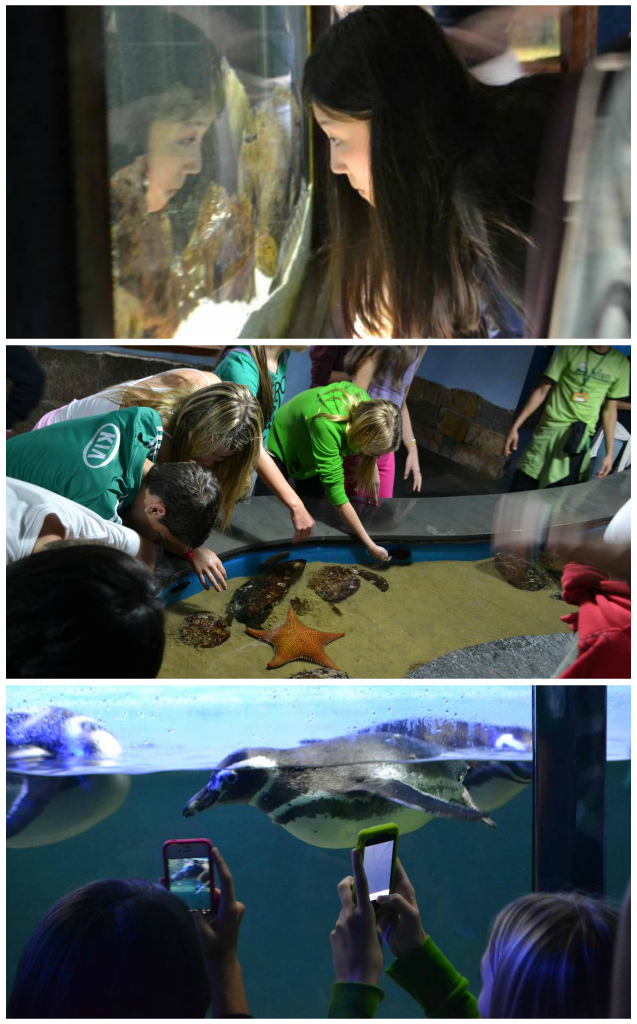
First up was a stop at Ubatuba's aquarium.  Modest in size but of good quality, the aquarium showcased the diversity in marine life in and around Brazil.  Also, there were penguins, which are not endemic, however, who is going to complain about seeing penguins?!?

The marine area around Ubatuba lays claim to being the seasonable home to four out of the five sea turtles found along Brazil's coast.  Thus, with good reason, the Projeto Tamar, a research and rehabilitation center for sea turtles, in located here.


On the second day we hopped on a boat and headed across the water to one of the many islands that speckle this part of the coastline.  Ilha Anchieta - now a State Park - was once a prison that is famous for a (almost) successful mass escape attempt.  (Side note: since I've been in this country, I have now visited a total of three shuttered prisons, two on islands.)

Sometime during the mid-1900's, the prisoners devised a plan to earn the guards' trust by essential being really, really well-behaved.  It took two years, but they eventually got to a point where they were essentially seen as a non-threat.  The prisoners, now trusted companions to the guards, waited for the day the scheduled supply boat would come to the island to turn on the guards.  They killed who they needed to then went to the dock to wait, but the ship was late due to unfriendly seas, leading the prisoners to get nervous and restless, ending with what amounted to a bloody massacre amongst themselves on the beach.  When the supply ship arrived, the prisoners who were left boarded and subsequently crashed/sank/overturned near the mainland, thus drowning most of those remaining.


Even though the island is only about 500m away from the mainland at its narrowest point, the guards had convinced the inmates that the waters were infested with sharks by occasionally placing shark skeletons and skulls on the beach as "proof." Due mostly to the embarrassment of the escape incident itself, along with the damage incurred from the beach riot, which also involved setting fire to many of the buildings, the prison was immediately and permanently shut down.

Listening to the history of the prison.
Now a protected State Park, the island is a unique preserved example of a unique ecosystem, the Mata Atlântica (Altantic Tropical Forest), that once covered much of the Brazilian coast and is now mostly limited to the stretch between Rio de Janeiro and just north of the city of São Paulo.  A few hours of hiking the island's trails, visiting a few beaches, snorkeling, and poking around in the tide pools, we were all exhausted and ready to head back to the boat.

Island flora and fauna: flower (top), vulture tracks on the beach (middle),
and Spanish moss dangling from a tree (bottom).
This is a beautiful area of the country - rich in nature, culture, and history.  I hope to be able to return in the near future to explore more of this coast, including Ilhabela and Paraty, perhaps with a little more beach beach time and a little less chaperoning!

Looking down the dock toward the mainland from Ilha Anchieta.

12 May, 2013

A Taste of "Sampa"

Mão (Hand) by Oscar Niemeyer
Despite its proximity to Campinas, I have yet to explore the largest city in all of the Americas and the capitol of the state I reside in.  I think the very closeness of this megalopolis is what makes it so easy to put off visiting, like people who know few of the attractions in their hometown until visitors come.

I've been to São Paulo before for various conferences and in-transit stops at airports and bus terminals, but those hardly count. At only about a 90 minute journey down the highway by bus, I really have no excuses!

Last weekend we were finally officially introduced.  On a day-trip with the Portuguese language school I attended - hopelessly, at times - twice a week, we visited several cultural points of interest in the city.  The first stop was the Memorial da América Latina, a large, predominantly concrete plaza and separate buildings designed by famed Brazilian architect Oscar Niemeyer.

The Niemeyer-designed Salão de Atos Tiradentes (Hall of Acts)

The complex included a museum of Latin American art from Brazil and many other countries including Mexico, Peru, and Guatemala, among others.  There was also an impressive map of South America set within the floor that visitors could literally walk above and cross in a few large strides.

Latin American art of all types!

Standing above the continent (top).
Looking down on Brazil (bottom).

Next stop was the Museu do Futebol (Soccer Museum).  Located underneath part of the stands of the Estadio Municipal Paulo Machado de Carvalho this is a "must see" and I would gladly take anyone here.  Exploring all things Brazilian soccer, each room and exhibition is sensory experience unlike anything I've experienced.  Strangely, though we were allowed to take photographs in all the other museums filled with preserved artifacts, taking pictures of any kind was prohibited here.

Proof of my visit: the outside, the field, ticket stub.

After that healthy dose of national pride we headed to the Memorial da Resistência (Resistance Memorial), a museum implemented to remember a darker time in the city's history.  Originally built as a railway depot, the building was later made into a place where political prisoners were held, officially called the State Department for Political and Social Order, from 1940 to 1983.

A view up at the Memorial da Resistência from the only
outdoor prisoner area, a stretch of hallway open to the elements.

Our final stop before heading back to Campinas was a quick stop along the Avenida Dr. Arnaldo, where a section of curb several blocks long is filled to the brim with flower stalls, open 24 hours a day for whosoever might need them.


Até mais, Sampa!  I'll be back...

24 March, 2013

The Key to Losing

They say "quitters never win."  Well, ain't that the truth.


You can't really lose a half-marathon.  You can win, sure.  Anyone who has ever crossed the finish line first can attest to that.  But you can't lose at running 21K.  You show up and finish or you don't.

You can lose your keys.

At some point just after km 3, a fellow racer tapped my shoulder and said something about dropping things.  I quickly assessed my being - ipod (check), timing chip on shoe (check), water bottles in belt (check, check), apartment key in back pocket (oh, crap).

Thus began the next fifteen minutes of retracing my steps, like a salmon against the flow of runners, eyes on the ground, asking each race official, "Perdi minha chave; você sabe algo disso?" (Loosely translated to: My dumb ass didn't zip the back pocket to my shorts and my key came flying out; have you seen it?)

I think Bruno Mars was telling me something...
On my second lap of the area where the key was mostly likely to have been lost, the third race monitor I spoke with approached me with the missing door-opening implement.  By that point the slower of the 10K racers were passing by.  Relieved, I thanked the guy and he wished me a boa prova.  "Agora, não vale a pena," I replied (It's not worth it now).

Fortunately, the course essentially wrapped around the neighborhood where I live, so I removed my conspicuous race number and walked home.  On the way I thought about how grateful I was that the gentleman in the race tapped my shoulder to let me know I dropped the key.  Obrigado, Sir!  This sentiment was short-lived, however, when I thought about the fact that this was a key.  Not a few coins, or a water bottle.  This is something people need to get into important life things, like cars and houses and safes.

So I call bullshit, Sir.  Had I been running behind someone and they unknowingly dropped a key, I would pick it up.  This was km 3, after all.  You have not hit your wall; your brain is still functional for logical thinking.  A considerate person picks that shit up.  I'm just saying.

I'm not passing the blame here - I should have triple-check the zipper on the pocket - I'm just disappointed.  It was a good three kilometers, though...

Race Swagg
What amounts to the most expensive bottle of sunscreen ever.

20 March, 2013

Who Run The World?

Living in a Latin American country it is impossible to not be exposed to and form an opinion towards the phenomenon of machismo.  Whether its men standing on a street corner whistling/hissing as a woman passes by, ignoring their every presence or the many real pre-conceived ideas of what Latin American women "should" do, it is impossible to ignore.

On Monday, March 18th, Barnard College hosted its fifth annual symposium on the topic of women and their roles in changing and empowering other women in their respective corners of the world.  After previously holding similar events in China, Dubai, India, and South Africa, the symposium was brought for the first time to the Americas, and to São Paulo, arguably one of the largest financial and cultural centers of the western hemisphere.

"Women Changing Brazil"
I accompanied a small delegation of students on behalf of my school's social justice club to the one-day event, composed of panels on various topics such as the arts, science/academia, and business.  Speakers included Kátia Lund, the director of the Oscar-nominated "Cidade de Deus" (City of God); Duilia de Mello, a Brazilian NASA astronomer; Adriana Machado, the CEO of GE Brazil; and Maria Cristina Frias, a columnist for the Brazilian newspaper Folha.  Brazil's Minister for Womens' Affairs, Eleonora Menicucci, was even on hand to give the keynote address.

With film director Kátia Lund (center) and my friend
and colleague Jocelyn following the "artists" panel.
While the panelists and discussions were interesting, it became evident quickly that the same recipe for addressing womens' issues in Asia, Africa, and the Middle East could not be applied to Brazil - or, to a larger extent, Latin America.  While the panelists, by and large, were from upper-middle class to wealthy backgrounds, and predominately white, they all still maintained, after repeated probing from the various moderators, that they did not feel they faced any significant amount of discrimination because of their gender.  (Answers like this tend to cause hiccups in a conference discussing oppression of women and their subsequent empowerment.)

One moderator - the President of Barnard College, Debora Spar - made the observation that the president of Brazil is a woman, as are over 30% of the elected officials, then asked, "What is Brazil doing right?"  While this question wasn't ever really answered, many of the panelists, especially the scientists and business leaders, maintained that the idea that women can not do certain things or be good at certain things - math, for example - is not something they heard or encountered until they ended up in the US for one reason or another.

The issue of machismo was brushed up against but never dwelled upon for more than a passing moment, as were other issues such as social class and racial perceptions.  By the end of the three panels, I feel it became clear that the arrow had hit slightly off-center of the cultural target.  There are issues that women face in Brazil, however, they are not the same glass-ceiling issues faced by women in other parts of the globe.  They are coupled with other factors; oppression in Latin America is not a woman's problem, though it does play a role, it is not the whole story.

12 March, 2013

Growing Accustomed

They say it takes about six or seven months living in a new place - foreign or domestic - before you begin to feel as if you've found a niche.  While I wouldn't go that far, I would say there have been some major affirmations making it easier to call Campinas home:

  • First and foremost, the barista at Starbucks greeted me by name without me having to give it.  She actually turned to her co-worker and her what to write on my café americano com leite.  Full disclosure: she had her write "Sergio" but in my mind it still counts!
  • My confidence in Portuguese is growing.  Recently the buses upped their rates from R$3 (roughly US$1.50) to the inanely obnoxious, pocket scrounging R$3.30.  One afternoon on the way home from work I paid with a R$5 bill and the attendant, after inexplicably rolling his eyes, gave me R$0.70 in change.  With a full bus watching I kindly pointed out his "error."  Jerk.  Also, hey six months of Portuguese being useful!
  • The annual saga that is the school science fair is over, and successfully, nonetheless!  Somehow, all 46 of the projects under my "guidance" came to fruition.  Be it noted: this is not the baking soda and vinegar volcano of your youth's science fair.  This is a months-long process, culminating in a formal - yes, little sixth grader, you must dress up - judges' interview and professional poster display. This year was also the 30th Anniversary of the fair's existence and the evening awards ceremony held the day after the judging reflected that.  I am proud to say, in the Middle School category, I had seventh graders win the first place individual prize, the first and second place team prizes, and the Hyundai-sponsored Innovation Award.  Honestly, though the students who won did most of the work themselves and were very self-driven; at best I was a glorified editor.
Top: Sign welcoming guests to the 30th Annual Science Fair!
Middle: One of the eventual winners discusses her project with a judge.
Bottom: The gymnasium transformed.

02 March, 2013

Street Food

Every Saturday a few blocks of a street in my neighborhood, Rua Maria Monteiro, gets blocked off and filled with vendors selling all sorts of produce and other goods, reminiscent of a Farmer's Market.  I try and go a couple times a month but sometimes Saturday mornings are for sleeping and hammocking with a cup of coffee rather than venturing into the civilized world.  Still, I've been meaning to play with my camera, and I decided today was the day:


16 February, 2013

The Other "Carnaval"

Or circus.  Or belated Halloween...at the beach.  Or...just Rio being Rio?

When one imagines Rio's "Carnaval" it is inevitable that the minds-eye is filled with flashes of feathers, headdresses, glitter, bedazzled thongs, and more feathers.  But not everyone is marching down the street in a sanctioned parade.  Many Cariocas (residents of Rio) choose to make their own parade, wherever they may stroll.

A lot like going diving into the Walmart bargain-bin on November 1st and putting on whatever you pull out. Why not just put on a blindfold and turn off the lights while your at it!  Now go about your regular business - pick up groceries, hail a cab, walk to the bank to use the ATM - sporting your new half-assed costume attempt.  Or throw on your beach wear and head to the beach!  What angel wings?  Bunny ears...who, me?!  This clown nose...hardly noticed it!

I attempted to document this phenomena by taking a sample of the streets, so to speak.  The following shots were taken from my phone whilst enjoying a late afternoon cerveja at corner sidewalk café in Copacabana over the course of about 15 minutes...

LMFAO, is that you?  I think Psy is following you...
Aye aye, Captain!
Seems to be a popular costume choice.
"Her name was Lola, she was a showgirl..."
There was also a baby, an angel, a mouse, an Indian, and a fairy in this group.
The weirdest part, other than the juxtaposition of urban city streets and swimsuits, was that everyone exuded an air of obliviousness to their own appearance, making the sporting of cast-off Halloween wear that much more alluring.  It was a bizarro world; a parade without a route, where the spectators are whoever happens by, and concerning oneself with a theme is irrelevant.  It's a city-wide costume party and everyone is invited!